TL;DR - It gets harder to really “go for it” as a man ages...but not in the ways you might think.
Intro
I just quit my comfy corporate job to build an open-source productivity app that makes $0 and costs thousands a month to operate.
Thanks for reading Time Management for Happy People! Subscribe for free to receive new posts and support my work.
It’s a big swing.
In fact, it’s the third time that I’ve quit a stable job in pursuit of a long-shot dream.
The first time I was 25. The second I was 28. Now I’m 32.
The objective is the same: make enough money to fund my dream life before going broke.
However, this time feels different.
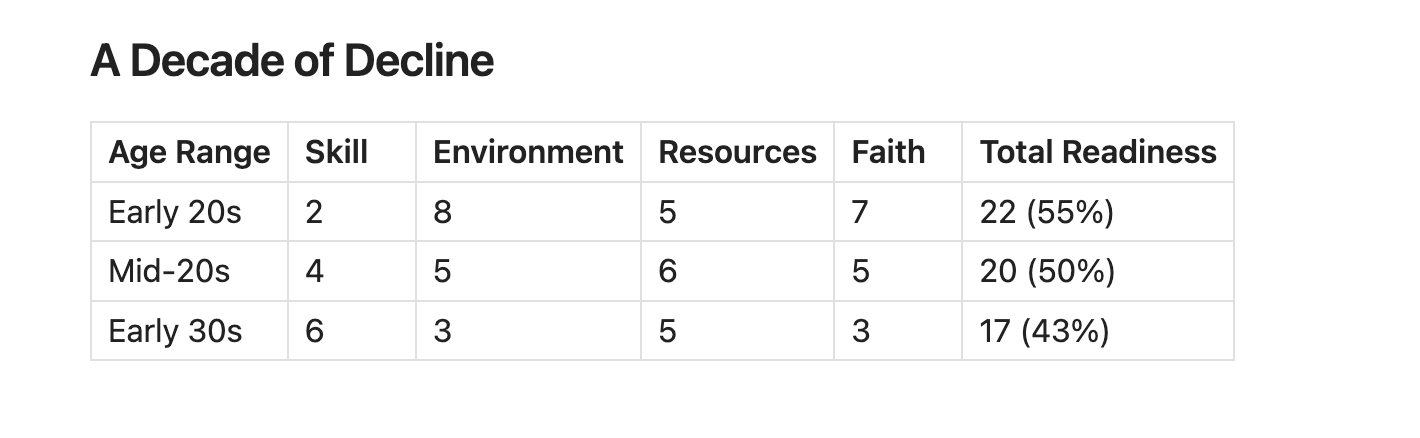
Namely, my skills, environment, resources, and faith have shifted.
After studying myself and dozens of young men who took big risks — and even more who wanted to but never did — I’ve noticed that these factors change predictably.
If you’re an ambitious guy in your 20s, consider this a scouting report for your future self.
Understanding these forces might be the difference between creating the life you’ve always wanted and staying stuck in the one that’s been given to you.
The 4 Forces
Think of entrepreneurial readiness as a combination of four forces
Skill (0-10): How good you are at creating and capturing value.
At 0: You have no idea how to create anything, let alone charge for it. No leverage
At 10: You can ship and convert easily, quickly, cheaply. High leverage.
Environment (0-10): How your surrounding influences you. Includes people, living space, pets, expenses, health.
At 0: Distractions, unhealthy, chaotic home, lots of responsibilities (pets, kids), high rent, isolation
At 10: Peaceful workspace, supportive network, motivated peer group
Resources (0-10): Your access to time, money, and connections
At 0: No time or money, debt, weak network
At 10: Flexible schedule, cash reserves, good credit, strong relationships
Faith (0-10): belief in self and your mission
At 0: Paralyzed by fear, massive ego, pessimistic worldview
At 10: Optimistic, ambitious, trusting, humble enough to learn
Notice how competence and readiness move in opposite directions
Early 20s
Skill: Creating value and capturing it requires product, marketing, and sales. You might be naturally good at 1-2, but not all three. You can overcome those deficiencies if you are great at one. Unless you started in your early teens, though, you’re not great. So, you’ll need to get the reps in. It’s a grind, but it’s also encouraging once you see progress.
Environment: Most of your existing friends won’t be rich, coupled, or even know where they’ll live in a few months. This fluidity makes your business endeavors seem less extreme. In fact, starting something at this age often boosts your status. Your ambition will be perceived as confidence. Few will try to convince you that it’s too risky — you have so little to lose anyway!
Resources: Your lifestyle is probably only slightly more expensive than it was in school, which means you can extend your runway with less. But you also don’t have enough free cash to reinvest in R&D or buying back your time.
Faith: You believe in your potential. You think, “Why wouldn’t I be able to make this work?” You haven’t taken enough Ls from friends, girlfriends, or the job market to get pessimistic. This leaves you naïve and vulnerable. But it also means that you’re not ruled by fear or your ego.
Mid-20s
Skill: You’re probably still not great, but you’re proficient. If you worked hard during those early years, you have adequate skills to make it work. You also know what great looks like and what it takes to get there.
Environment: A lot’s changed in a few years. You and your friends figured out taxes, moved cities, got a promotion, bought a car. You got your own apartment, then rescued a dog and moved in with your new girlfriend. Taking a big risk on a startup will start to feel more risky, especially as you watch your friends settle into their careers and lifestyles.
Your life is more complicated with no signs of reversal.
Resources: Your income went up a lot, so you don’t feel bad about the higher rent or fancier vacations and clothes. That dog you got is cute, but it sure has a lot of energy, which means you have less time.
Faith: You know your skills are better. But doubts start creeping in. “Wasn’t Zuck like 18 when he started Facebook? Should I have dropped out and started earlier? Will Cindy leave me if I fail? If I stay I’ll have enough for a downpayment in 12 months — I can’t risk that.”
Your sensitivity to failure has inflated as quickly as your lifestyle.
Early 30s
Skill: You’re now a “Senior” or “Lead.” You’re approaching greatness in at least one area, and you’re confident that you could stack that with proficiency in the other two areas. In theory, you know you can do it at this point.
Environment: You’re probably engaged, married, or a father. If not, you feel pressure to catch up to your friends who are. Your living environment is more chaotic. Having entrepreneurial ambitions is likely to alienate you from others your age, as they’ve already made peace with the employee path.
Resources: It’s harder than it used to be to carve out long periods of focus. You have more income than ever before. You might be seeing the investments in your early 20s compounding, which makes you want to just invest even more in the market. But that’d mean you’d have less to invest in your own business — hmm.
Faith: The stakes seem higher now. Starting over means throwing away your education and the experience from your early jobs. Failing would strain your relationship and potentially your kids’ futures. You think, “I’ve made it this far and it’s going OK. What if I just kept going?” Your fear overshadows your authentic dreams. You come up with plenty of rational excuses for minimizing your ambitions.
Takeaways
Starting sooner is (slightly) better
The obvious takeaway is that the earlier you start, the better.
Surprisingly, it’s not that much better.
The least advantageous portion of this decade is only 12% harder than the most.
Each phase comes with valid reasons to play it safe.
The real danger with waiting is that you become better at believing your own BS.
The longer you wait, the more pain you’ll need to experience before being willing to change.
Stay contrarian
The right action at each stage is the opposite of what the others your age are doing naturally.
If everyone is partying, study.
If they’re buying houses in the ‘burbs, move to the city and get 3 roommates.
If they’re getting dad bods, get jacked.
If their careers are stabilizing, jeopardize yours.
Remember: you want an output that is the opposite of what these people have.
Why wouldn’t the inputs have to be polar opposite, also?
Accept the price
Depending on the day, a big risk can feel either empowering or crippling. Emotions are naturally volatile in games where outcomes are non-linear.
Accepting the price for your dream life helps keep these emotions under control.
The pursuit of your dream might require that
You lose all your current friends
Your family relationships are strained
You don’t get that dog
You breakup with your girlfriend
You don’t hit any PRs in the gym
You don’t buy a home or move into the nice apartment
You cook instead of eating out
The moment you make peace with those trade-offs is the moment that you reclaim control over your emotions.
This game rewards those who surrender and punishes those who try to negotiate the rules.
How willing are you to accept that?
Thanks for reading Time Management for Happy People! Subscribe for free to receive new posts and support my work.